Showing posts with label 5 Steps to Success. Show all posts

Wednesday, January 20, 2016

TECHNOLOGY AND INNOVATION


Technology and Innovation are powerful tools for revolution, in both positive and negative ways. As we commence to face up to the multiple economic, environmental and social challenges of our time. The innovation of online shopping has made it easier to buy goods quickly and often much cheaper. Technology has become a positive effect on the economy because consumers tend to make more informative decisions on products with the use of technology. When people make confident buying decisions, the economy typically does better. 

New kinds of technology increase the productivity and thus lower the cost of production. Consumer spending has increased because of technology, which leads to a healthier economy.

How can the Innovative Ideas bring a positive social change?

Coming up with an innovative idea will require some procedures of creating ideas from brainstorming to mind mapping that can help educate up to useful ideas. During this process one must make sure to keep focused on a goal.

If you have no goal, how will you know when you have reached the finish line and are ready for refinement?

·      Start out with an innovative ideas and see what you can come up with
·      Don’t get stuck on trying to come up with different alternatives of the same idea as you will want to develop ideas further later

While there is no exact trail in creativity techniques from start to finish, creating an idea you are happy with and feel has innovative potential is the key. Believing in your ideas innovative ability which will give the confidence you will need later on during pitch time.

It is easy to come up with new innovative idea but if that is the case, then why didn’t we do it? The trick is to come up with them beforehand. That’s the challenge. Once you discover that exceptional innovative idea, try to avoid crucial mistakes that will stop your idea from ever seeing the light. To truly be innovative, you should take challenging opinions and combine them, which spreads the innovative potential of your idea. Innovative ideas can sometimes be volatile but many hypothetical hurdles will arise and just having an innovative idea is not always enough.

In order to take an innovative idea from the start to market, you need to have the determination to push through failure. As motivating as some ideas may be, that is not always enough for users. Receiving the message out that your new innovative idea is essential would gain more consumer attention, especially in more difficult economic times. Always having a short and clear value proposal with an inevitable feeling of necessity can help gain capital, experience and users.

Do not wait until everything is “perfect” as they may never be and this will only further delay your ideas release. Don’t be intimidated by the observed skill of innovative designs, because you are typically seeing the ultimate repetition that has changed compared to its original idea.

 ACT SMART -  DO NOT REST POINTLESS!


Wednesday, October 28, 2015

PREPARE YOURSELF TO START A STARTUP

I KNEW THAT I FAILED I WOULDN’T REGRET THAT, BUT I KNEW THE ONE THING I MIGHT REGRET IS NOT TRYING. – JEFF BEZOS, AMAZON 

Starting a startup is a task where you can't always trust your instincts. Running your own business takes guts, assurance and an enduring passion for what you do. If you know nothing more than this, you may at least pause before making them. Before you kick start, always believe in yourself and focus on the subjects that matters to you the most.  You can, however, trust your instincts about people. The most common mistakes young Entrepreneurs make is not to do that enough. They do get involved with people who seem exciting, but about whom they feel some misgivings personally. Later when a thing goes wrong then they say "We knew there was something wrong about him, but we ignored it because he seemed so impressive."

This is one case where it pays to be self-indulgent. Work with people you genuinely like, and you have known long enough to be sure – “CHOOSE THE RIGHT PARTNERS”

You need an expertise to give you advice that surprises you.


“WE AT VENTURE ART PROVIDES YOU WITH THE BEST AND INNOVATIVE SOLUTIONS” - http://www.ventureart.biz/

Passion may be what attracts you to your new startup, commitment is what keeps you going. Commitment are shown in the conscious effort you make to stay on track or in the decisions; you make each day to do the things that needs to be done, even if they are boring or difficult. Learning new and latest ideas is an art that one could acquire with passion.  A passionate learners will always know the current demand of the society, which you could make him aware of the scenario.

Fit your attention into the type that startup ideas:

·      Get Innovative Ideas
·      Learn a lot about things that matters you and society
·      Work on problems that interest you
·      Work with individuals you like and respect

The way to succeed in a startup is not to be an expert on startups, but to be an expert on your customers and the problem you're solving for them. Choose the right partners who could give you innovative ideas, and make sure they are sustainable. This expertise should be able to guide you through all phases of the growth of your business. A comprehensive approach should be taken at any situation during the business process and importantly the outcome for the approach is essential.

Commitment is the fuel that keeps the engine turning over for the long haul. The entrepreneurial journey is a tough one. When you combine your spirit with commitment, and allow your passion to inspire you, the result is one of the hallmarks of successful entrepreneurs.

The way to come up with good startup ideas is to take a step back. Instead of making a conscious effort to think of startup ideas, turn your mind into the type that startup ideas form in without any conscious effort. In fact, so unconsciously that you don't even realize at first that they're startup ideas.


Young Entrepreneurs' first instinct on starting a startup is to try to figure out the tricks for winning at this new game. Since fundraising appears to be the measure of success for startups, they always want to know what the tricks are  for investors. The best way to satisfy investors is to make a startup that's actually doing well, meaning growing fast.

Depending on how wrecked the company is you can succeed by lapping up to the right people, giving the impression of productivity, and so on. Startups are as impersonal as physics. You have to make something people want, and you prosper only to the extent you do.

At its best, starting a startup is merely a mysterious motive for curiosity. And you'll do it best if you introduce the ulterior motive toward the end of the process.

So for young entrepreneurs, who would like to start a startup remember to boiled down to two words: JUST LEARN – “Paul Graham, Entrepreneur”


Friday, October 23, 2015

Lack of competition stops SME owners from switching accounts, finds CMA


Banks aren’t working hard enough to compete for customers, with SME owners sticking to their original current account supplier when searching for business loans, the Competition and Markets Authority (CMA) has found.

Lack of movement within the sector

The consumer watchdog has published its conditional findings of its long-term investigation into 12 banks and building societies that provide personal current accounts (PCA) and business current accounts for consumers and small businesses.
In its report, the CMA noted that nearly 60 per cent of consumers have been supplied with their PCA by the same bank for over ten years, with 37 per cent sticking it out for over 20 years with the same lender.
This lack of movement within the personal account market has been put down to an absence of information on new products and service quality.
Customers are further hampered by the severe lack of any price comparison tools, which makes it harder for them to find a better deal on their current accounts.
This has resulted in just three per cent of customers switching PCAs in 2014, with only 16 per cent of people browsing the market for a better deal. Work has been done to create more competition, with the Current Account Switch Service (CASS) launched in September 2013.
This lack of information from banks is keeping consumers from reaping economic rewards. Consumers that use a PCA with a large overdraft limit can save approximately £260 a year if they switched banks, with the average person saving £70.

SME owners tend to stick with the same provider

Small business owners are suffering the same problem as consumers, with many sticking to the same current account provider when looking for a loan. When the initial free banking period comes to a close, 90 per cent of SME owners stay with their providers instead of going elsewhere.
Commenting on the report, Alasdair Smith, chairman of the retail banking investigation, has placed much of the blame on the banks, with financial institutions being able ‘‘to sit back and take their existing customers for granted.’’ Smith added that customers won’t benefit until more comparison tools are created to help customers and small businesses switch without any risk.
‘‘We are considering a series of measures that will have a far-reaching impact on how banks operate and will empower account-holders to search for and switch to the account that suits them,’’ said the chairman.


What is being done to change this?

The credit authority has made a number of recommendations to improve banking services for SMEs, including the creation of a price comparison site for small business owners.
Also high on the list of potential remedies was  enabling banks to prompt business owners to review their account services during so-called ‘trigger points’ which occur in certain situations including a loss of service, closure of their local branch, unarranged overdraft charges or a change in the terms and conditions of their account. For SMEs the trigger points usually occur when their free banking period has ended.
Controversially, the CMA has decided not to recommend changes towards ending free if-in-credit (FIIC) accounts, with the investigation finding no evidence that FIIC affects competition. Tory MP Andrew Tyrie has slammed the CMA on the decision, branding free-if-in-credit accounts as a ‘con trick’.
‘‘It seems reasonable that millions of customers should be allowed to know how much they are being charged for having a bank accounts,’’ said Tyrie.
The Federation of Small Businesses (FSB) has welcomed the CMA’s interim findings, with national chairman stating that ‘‘A well-functioning banking market for small businesses is critically important to support UK economic growth.’’
However there are some SME lenders who feel the report doesn’t go far enough.
James Sherwin-Smith, CEO of lending platform Growth Street is concerned that there is no requirement for commercial finance products to carry an APR.
‘‘Without a standard price indicator, it is unclear how SMEs will be able to compare prices, even if the proposed remedies are adopted,’’ explained Sherwin-Smith.
‘‘This is badly needed to help simplify the complex charging structures employed by banks and others to charge SMEs more than they anticipate, and would result in a lower cost of SME finance and higher business and economic growth.’’
Citation from SME Insider :http://goo.gl/ZnVOEe

Tuesday, October 13, 2015

Drone Startup CyPhy Works Gets $22 Million Boost From Bessemer Venture Partners

Drone startups are beginning to take flight, at least in the world of venture capital.


On Wednesday, Danvers, Mass.-based CyPhy Works said that it had raised $22 million in a round of funding led by Bessemer Venture Partners. The announcement is the latest in a series of private investments in companies in China and the U.S. building unmanned aerial vehicles (UAVs) for the consumer market.
Led by iRobot IRBT +0.10% cofounder Helen Greiner, CyPhy (pronounced Sci-Fi) did not disclose its valuation following the round, which brought its total funding to more than $30 million. Previously the company had raised $7 million from Lux Capital in Nov. 2013 and concluded a Kickstarter crowdfunding campaign in June for its six-rotor LVL 1 drone, raising nearly $900,000.
The company is “looking forward to working closely with our new strategic investors to accelerate adoption of drones into public safety, construction, agriculture, journalism, mining, defense, and other fields,” said Greiner in a statement, citing not just Bessemer but also UPS Strategic Enterprise Fund, a private investment arm of the shipping company, and Motorola Solutions Venture Capital.
While the likes of Amazon have stoked the public’s imagination of flying robots delivering packages, CyPhy Work’s investment partnership with UPS doesn’t necessarily mean the company will be jumping head on into drone delivery. However, as its previously announced relationship with Motorola shows, CyPhy is using deals with corporate players to gain exposure for its relatively new and experimental technology.
“We have a strategic relationship with Motorola’s public safety division [which covers] most of the nation’s public security,” said Greiner at the TechCrunch Disrupt Conference in San Francisco last month.” We want to leverage that to get drones into police, fire fighters and others, across the world and not just the U.S.”


CyPhy Works Series B round comes after other companies building drone hardware have raised millions. In May, DJI, the world’s largest consumer drone manufacturer, took in $75 million from Accel Partners at an $8 billion valuation. That was followed by fellow Chinese companies and competitors EHANG and Yuneec, raising $42 million and $60 million respectively, in August.
CyPhy Works biggest differentiator from its Chinese counterparts is that it has built tethered drones, connecting flying robots to users with a fishing line-type filament, which the company said allows for unlimited flight times, improved control and better video processing. Its Persistent Aerial Reconnaissance and Communications (PARC) vehicle system, which was initially built for military-use cases, utilizes this tethering technology, and Greiner said that the funding will go a toward the commercial launch of that model. (The company’s Kickstarter drone, LVL 1, does not feature tethering.)
“CyPhy Works has produced the first truly differentiated drone and as we see more industries leverage this technology, we expect they will capture significant market share,” said Bessemer Venture Partners’ Felda Hardymon, who joins the company’s board with the investment.
Other participants in the $22 million round include Draper Nexus Ventures and existing investors Lux Capital and General Catalyst Partners.

Citation from Forbes : http://goo.gl/bq6g8n

Sunday, October 11, 2015

10,000 STARTUPS A DAY BEING SET UP IN CHINA TO BOOST ECONOMY


BEIJING: More than 10,000 startup firms are being set up everyday in China as part of new reforms initiated by the Chinese government to halt the slide of the economy.
China sees more than 10,000 firms born every day amid government support forentrepreneurship and so far about six million new startups have been setup, Xin Guobin, vice minister of Industry and Information Technology said.
Most of the firms are small enterprises. Data was collected last March through the end of August this year and about six million firms were registered during the period, he said.
The government has been cutting taxes and fees, helping small firms save about 48.6 billion yuan ($7.93 billion) in the first half of the year, Xin said.

Lending to small firms stood at 16.2 trillion yuan ($2.7 billion) at the end of June, up 14.5 per cent from last year, Xin said.
However, he admitted small firms are facing challenges amid economic slowdown, slumping product prices, rising costs and production overcapacity.
The new startup campaign has been initiated by the government as the economic slowdown is causing big job losses all over China.
The startups, were expected to revitalise the economy taking advantage of the booming e-commerce.

The campaign was also expected to boost government's drive to boost the domestic consumption changing the orientation of the economy from export dependent to that of the one based on domestic consumption.
Chinese economy is currently hovering around seven per cent.
According to IMF, China's growth is expected to slow from 7.3 per cent in 2014 to 6.8 per cent this year and 6.3 per cent in 2016 as the country struggles with its shift from export to consumption-driven economy.

Citation from Economics Times :http://goo.gl/CY1aVJ

Friday, October 9, 2015

BOOMING STARTUPS NOT BUBBLES

"Startups are neither a bubble nor a complete game changer. I am sure the traditional things will survive, it (startups) will expand the market," Essel Group, Chairman, Subhash Chandra said last night at the Exchange4media Conclave.


Essel Group Chairman Subhash Chandra has said the country's booming startup space is not a bubble, rather it will help expand the overall market in the coming days. "They (startups) are neither a bubble nor a complete game changer. I am sure the traditional things will survive, it (startups) will expand the market," Chandra said last night at the Exchange4media Conclave. Chandra added that when he started the country's first satellite television channel Zee TV 23 years ago, the film and theatre industry were wary and felt that it would mark their end. "I remember that when I started (satellite) television in this country, the film industry felt we will kill the film industry and theatre industry but the reverse happened. We promoted the films, we partnered with the movie industry and both grew. Same way the technological startup companies will continue," he said. He said the e-commerce companies have found success as they are able to cater to the needs of people from smaller towns or the rural areas where products were earlier not available due to supply chain constraints. 

Stating that technology will help in expanding the market and things will co-exist, he debunked the myth that linear television will cease to be around after a decade. "People say the linear television as it exists today, 10 years from now it will be dead. At Zee, we do take technology seriously. We are ahead at least in Asia in terms of adopting technology. But I feel this (linear television) will survive but at the same time new media. It will give more opportunities to marketers and expand the market as a whole," he said. 

Essel Group is in the process of launching an English news channel and Chandra said it will be positioned as a technology company providing news. "We are about to launch an English news channel. We were discussing the whole technological engine we are going to use. I understood what technology my colleagues wanted to introduce in the news space. "I said why don't we have a vision that we are not going to be a news organisation but we are going to be a technology company incidentally giving news as a product. That is the positioning we have decided last week, for our English news channel," he said.

Citation from CNBC Money Control : http://goo.gl/GRiLdQ

Monday, July 27, 2015

Tech business week: Start-up map and financial results revealed

Start-up map of Ireland goes online

A very useful, living and breathing online map has been produced by Start-up Ireland that takes into account the entire start-up ecosystem in Ireland, including start-ups, accelerators co-working spaces and more.
Produced ahead of the Start-up Gathering this October, the map will always be a work in progress.  For anyone trying to get a grasp of the start-ups of today, access incubators, investors, co-working spaces, accelerators and lots more, it is a fine, detailed piece of work.

Apple reports US$49.6bn quarter, says little about Apple Watch

Apple has been circumspect about the performance of its Apple Watch wearable except to say it got off to a ‘great’ start. The company reported a US$10.7bn profit on third quarter sales of US$49.6bn.
Apple reported third-quarter growth was fuelled by record numbers of iPhone and Mac products and strong revenue from services.
“We had an amazing quarter, with iPhone revenue up 59pc over last year, strong sales of Mac, all-time record revenue from services, driven by the App Store, and a great start for Apple Watch,” said Tim Cook, Apple’s CEO.

Microsoft posts US$2bn loss on US$22.1bn in Q4 revenues

Software giant Microsoft has incurred losses of US$2.05bn on fourth quarter revenues of US$22bn, which the company attributed to the costs associated with the US$7.5bn writedown for its acquisition of Nokia Devices as well as restructuring charges of US$780m.
Microsoft also blamed its poor fourth quarter results on the strengthening of the US dollar.
There was also a further charge of US$160m associated with the company’s restructuring.

ChangeX raises €400k seed round

ChangeX, a not-for-profit start-up, has raised €400,000 from a coterie of investors including Storyful founder Mark Little, Ben & Jerry’s co-founder Jerry Greenfield, prominent Irish financier Dermot Desmond and some high-profile Silicon Valley investors.
The investors also include: John O’Farrell, general partner of Andreessen Horowitz; Albert Wenger, managing partner at Union Square Ventures; Realex founder Colm Lyon; Brian Caulfield from DFJ Espri and Bil McKiernan from WMC Capital.
“I’m a long-time supporter of and believe in the power of grassroots movements and ChangeX has the potential to really accelerate their growth and impact and that’s important for the world,” Greenfield said. “I’ve known Paul for a few years now, I like his work and I’m just delighted to support him and the team in getting ChangeX to fly.”
ChangeX, which was our Boole Start-up of the Week in recent weeks, connects people with the best ideas and like-minded people so they can work on causes that they are passionate about.

Qualcomm to slash 15pc of workforce

Smartphone chipmaker Qualcomm — maker of the Snapdragon processor — is to slash 15pc of its workforce amidst a global slowdown in chip demand and pressure from an activist investor.
Qualcomm, a US$105bn technology powerhouse, employs 31,000 people worldwide and believes it could cut US$1.1bn a year in annual costs by cutting 4,500 workers by 2016.
Qualcomm, which operates a global R&D operation in Cork and is an investor in Dublin tech firm Cubic Telecom, has been under pressure since activist hedge fund Jana Partners acquired a US$2bn stake in the company.

9 out of 10 Irish adults bought online in the last year

The digital economy is alive and kicking in Ireland with nine out of 10 adults making purchases online in the last year. But Irish firms are missing out because 91pc of them don’t have e-commerce capabilities.
New research from Deloitte shows Irish consumers are no longer using the internet to simply source information. Engaging with businesses and other consumers, as well as sharing experiences, is becoming an increasingly important part of the purchasing decision and the majority of consumers under the age of 35 put most of their trust in anonymous online consumer reviews.
Clothing and footwear (49pc), hotel and accommodation (46pc), transport services (44pc) and books, music and games (42pc) are amongst the most popular items purchased online.
Citation from Siliconrepublic : https://goo.gl/JUaNiC

Wednesday, July 22, 2015

Silicon Valley startups go farming

Agriculture tech is a hot space for venture capitalists and entrepreneurs.

Silicon Valley, often accused of following the herd, is doing that quite literally when it comes to startups building technology for farmers. Some of the most well known venture capitalists and entrepreneurs are now focused on bringing the latest computing technologies — data analytics, cloud computing, mobile apps — to farms.
On Wednesday, farming software startup Granular said that it has raised a new round of $18.7 million in funding from investors Andreessen Horowitz, Google Ventures, and Khosla Ventures. New investors in the round, which is Granular’s second, included Tao Capital Partners, Emory Investment Management, Fall Line Capital, and H. Barton Asset Management.
Granular debuted last year from the split of another startup called Solum that was founded in 2009. Agriculture giant Monsanto acquired the half of Solum’s business that sold soil testing and data tech to farmers and folded it into the data team it acquired in 2013 from data startup Climate Corp.
Solum’s remaining technology, which is software, cloud-services, mobile apps and collaboration tools for farmers, was spun out into Granular. Now Granular’s software is helping a handful of farmers manage their farms more efficiently, using less water and less fertilizer. The tech enables them to tap into detailed data about how their farms operate in real time and, presumably, make better decisions.
For example, Ohio farmer Mark Bryant has been using Granular’s software to manage his farm’s operations, budget, and inventory tracking. Granular introduced its software last year with seven Midwestern farmers who also helped the company design the original software.

Granular is just one of dozens of startups trying to sell tech to farmers. The company is focused on the thousands of big farm owners that account for a third of U.S. farmland. These large farmers are increasingly buying up land from smaller farming operations and are looking for new tools to manage it all.
Not only has the agriculture industry been slow to adopt tech, but farmers are increasingly looking to use tech to reduce their use of water and fertilizer to save money. Water shortages from droughts are expected to become more common. As the world population hits 9 billion in 2050, farmers will have to produce more food, with less resources.
Extreme weather aggravated by climate change is also making farming more risky. Farmers are looking to use more tech to better deal with the potential weather problems.
Between 2013 and 2014, Silicon Valley’s interest in backing agriculture and food-related startups doubled in terms of deal size, according to data from the Cleantech Group. In 2014, 151 startups focused on agriculture and food (not including biofuels, but including some of the on-demand food startups) were funded to the tune of $976 million.
That funding FAST-PACE looks like it will continue this year. In May farming data startup Farmers Business Network raised $15 million from Google Ventures, Kleiner Perkins and DBL Investors. Other farming tech startups include FarmLink, Adapt-N, Farmers Edge, FarmLogs,aWhere, Granular, Farmeron, OnFarm, Agralogics, Blue River Technology and Precision Hawk.
Citation from Fortune : http://goo.gl/BmQ1QB

Startups Can’t Afford To Ignore Government


Last week, California threatened Uber with license suspension for failing to comply with state laws. Last month, Santa Monica banned Airbnb vacation rentals. But in spite of regulatory challenges faced by companies like Airbnb and Uber, entrepreneurs still act like government isn’t an issue. After all, startups are disruptors, and government is just a monolithic barrier to innovation, right?
Government as enemy?
 The prevailing view in Silicon Valley is that entrepreneurs are changing the world, while government is just standing in the way. And it’s exactly this mentality and media narrative of the ‘disruptors’ versus the ‘regulators’ that’s holding back our startups.
A new era in startup innovation
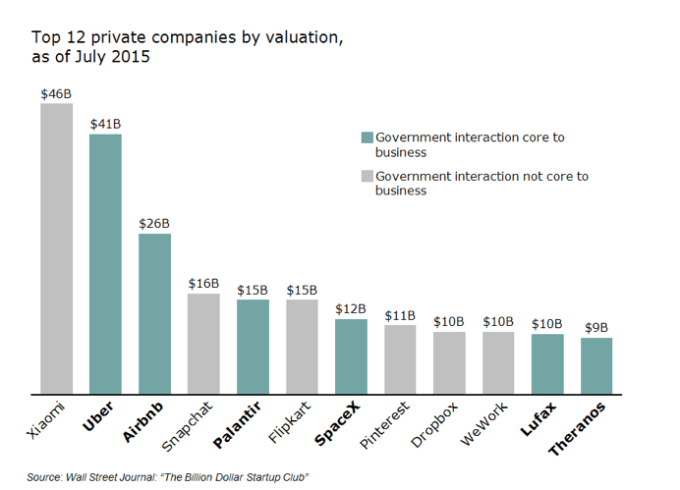
The truth is that government is now more critical to the success or failure of startups than ever before. Many of today’s largest and most successful private startups are playing in a public space that is highly politicized, highly regulated, or traditionally run by government.  Let’s take a look at the data.
image
For half of the most highly valued, venture-back private companies, interaction with government is core to their success. The top five list is even more telling – between Uber, Airbnb, and Palantir, you have the GDP of a sizeable country.  And this trend continues as you go down the “unicorn” list of billion dollar startup valuations – from employee benefits platform Zenefits, and fintech startups like Stripe and Credit Karma, to energy company Bloom Energy.
Just a few years ago, the move of startups towards highly regulated industries was unthinkable. But, with governments now cash-strapped and unable to provide all the quality-of-life services for residents, entrepreneurs are uniquely positioned to step in.
And clearly, if startups can master the tight-rope act of engaging with government, they can be big winners.
Moving beyond the philosophical and into the practical
It’s time for startups to stop treating government with disdain or, even worse, ignorance. There is a clear business case for working with government. But you have to be savvy. Let’s take some lessons from entrepreneurs in the trenches.
1) Not everyone will like you just because you’re innovating
 In fact, people may hate you more because you’re disrupting highly entrenched industries. And they will actively try to run you out of town.
Take the example of Zenefits – a startup that helps small businesses manage employee benefits. The startup is disrupting the health insurance market by cutting out the middlemen, known as health care brokers. Earlier in 2015, the Zenefits business model was declared illegal by the state of Utah, on the basis that its model violated a law against rebates. While consumers love Zenefits, the insurance brokers cried foul.
Zenefits proactively engaged government and regulators to change the situation. Fortunately for Zenefits, Utah’s governor and legislature stepped in, clarifying that the Zenefits business model is legal earlier this spring. Just a few weeks later, Zenefits announced a funding round of $500 million at a $4.5 billion valuation. Clearly, it pays to engage with government.
2) Your approach matters
 You need to be tactical about when and how to engage with regulators.
Let’s take the example of Night School, a shuttle service that would use school buses to transport individuals between San Francisco and Oakland, in the evenings, when public transit was slow or nonexistent. But the startup was shut down before they could fully launch. Unfortunately for Night School, they engaged with regulators in the wrong way. They asked for permission before they had broad-based community support or validation of their service. And without a war chest of funding, they couldn’t afford to fight.
3) It takes a village
Productive engagement with government requires investment of time and human resources.
Let’s look at Airbnb. Airbnb has experienced a backlash in some cities around taxation and fears that it reduces the affordable housing supply. But the startup has taken an incredibly proactive approach to working with government. First, they speak the language of government – collecting and sharing data on housing impacts, spending, and tourism.
Second, Airbnb has a collaborative approach to lobbying – with an expansive government relations and civic partnerships team, public relations, lobbyists, and key lawyers to help navigate the complexity. It truly takes a village to work with government, and Airbnb’s village is designed to productively engage policymakers.
Uber is an exception
 Perhaps no company’s battles with regulators have been as public as Uber. The ridesharing service has grown to 300 cities across the globe, developing notoriously antagonistic relationships with many regulators along the way.
And frankly, Uber is going to be successful in spite of itself because it has the money to fight these battles. Its combative strategies have alienated a lot of regulators – and this is going make it more difficult for the new startups that come after them.  Which is why it’s important for startups to work even harder to engage with government. Because, unlike Uber, you probably don’t have the multi-billions in cash to fight.
Wake up and smell the regulation
We’ve entered a new era of startup innovation – one where government will mean life or death. It’s time for startups to get over their indifference to government. In this era, the most successful startups will see government as a partner, not a problem.
Citation from TechCrunch :http://goo.gl/StgQun

Wednesday, July 15, 2015

The Startup's Guide to Doing Keyword Research Like The Pros


As the owner of a new online business, one of your biggest challenges is likely cash flow. Unfortunately, the only solution to this problem (besides a generous influx of investor cash) is to start driving search engine traffic and generating revenue – fast.

And herein lies the classic catch 22: you can’t get your site ranking without hiring a professional SEO, yet you can’t afford to pay an SEO until your site begins ranking and making money.

So, what’s a startup to do?

In this post, I’ll provide you with a framework for doing your own keyword research, just like the pros. I’ll take you step by step through the process of finding relevant keywords and then analyzing the sites that rank highly for these terms. I’ll also show you exactly which tools the pros use, and explain how you can use them to find high value keywords to incorporate into your own site.

But first, let’s take a look at some important principles that will impact how you select the ideal keywords for your site.


The term sometimes brings to mind old-school SEO techniques like keyword stuffing or including hidden text on a page as a way of ranking. But when it comes down to it, keyword research – and the ensuing incorporation of those keywords into a site – is more about understanding and using the language and terminology your target market uses in search.
When you understand what words people are looking for, you can provide content that does a great job of covering these topics and themes.
Another important aspect of keyword research is competitive analysis. Analyzing the top-ranking sites for your keywords allows you to determine which keywords are actually realistic for your business. Without this critical step, you could find yourself wasting time and money targeting keywords that you never had a chance of ranking for.

Citation from Forbes : http://goo.gl/3Tmt8H