
Last week, California threatened Uber with license suspension for failing to comply with state laws. Last month, Santa Monica banned Airbnb vacation rentals. But in spite of regulatory challenges faced by companies like Airbnb and Uber, entrepreneurs still act like government isn’t an issue. After all, startups are disruptors, and government is just a monolithic barrier to innovation, right?
Government as enemy?
The prevailing view in Silicon Valley is that entrepreneurs are changing the world, while government is just standing in the way. And it’s exactly this mentality and media narrative of the ‘disruptors’ versus the ‘regulators’ that’s holding back our startups.
A new era in startup innovation
The truth is that government is now more critical to the success or failure of startups than ever before. Many of today’s largest and most successful private startups are playing in a public space that is highly politicized, highly regulated, or traditionally run by government. Let’s take a look at the data.
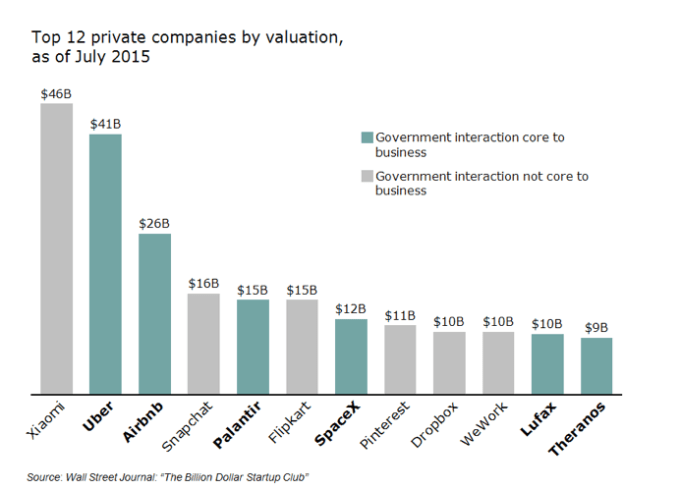
For half of the most highly valued, venture-back private companies, interaction with government is core to their success. The top five list is even more telling – between Uber, Airbnb, and Palantir, you have the GDP of a sizeable country. And this trend continues as you go down the “unicorn” list of billion dollar startup valuations – from employee benefits platform Zenefits, and fintech startups like Stripe and Credit Karma, to energy company Bloom Energy.
Just a few years ago, the move of startups towards highly regulated industries was unthinkable. But, with governments now cash-strapped and unable to provide all the quality-of-life services for residents, entrepreneurs are uniquely positioned to step in.
And clearly, if startups can master the tight-rope act of engaging with government, they can be big winners.
Moving beyond the philosophical and into the practical
It’s time for startups to stop treating government with disdain or, even worse, ignorance. There is a clear business case for working with government. But you have to be savvy. Let’s take some lessons from entrepreneurs in the trenches.
1) Not everyone will like you just because you’re innovating
In fact, people may hate you more because you’re disrupting highly entrenched industries. And they will actively try to run you out of town.
Take the example of Zenefits – a startup that helps small businesses manage employee benefits. The startup is disrupting the health insurance market by cutting out the middlemen, known as health care brokers. Earlier in 2015, the Zenefits business model was declared illegal by the state of Utah, on the basis that its model violated a law against rebates. While consumers love Zenefits, the insurance brokers cried foul.
Zenefits proactively engaged government and regulators to change the situation. Fortunately for Zenefits, Utah’s governor and legislature stepped in, clarifying that the Zenefits business model is legal earlier this spring. Just a few weeks later, Zenefits announced a funding round of $500 million at a $4.5 billion valuation. Clearly, it pays to engage with government.
2) Your approach matters
You need to be tactical about when and how to engage with regulators.
Let’s take the example of Night School, a shuttle service that would use school buses to transport individuals between San Francisco and Oakland, in the evenings, when public transit was slow or nonexistent. But the startup was shut down before they could fully launch. Unfortunately for Night School, they engaged with regulators in the wrong way. They asked for permission before they had broad-based community support or validation of their service. And without a war chest of funding, they couldn’t afford to fight.
3) It takes a village
Productive engagement with government requires investment of time and human resources.
Let’s look at Airbnb. Airbnb has experienced a backlash in some cities around taxation and fears that it reduces the affordable housing supply. But the startup has taken an incredibly proactive approach to working with government. First, they speak the language of government – collecting and sharing data on housing impacts, spending, and tourism.
Second, Airbnb has a collaborative approach to lobbying – with an expansive government relations and civic partnerships team, public relations, lobbyists, and key lawyers to help navigate the complexity. It truly takes a village to work with government, and Airbnb’s village is designed to productively engage policymakers.
Uber is an exception
Perhaps no company’s battles with regulators have been as public as Uber. The ridesharing service has grown to 300 cities across the globe, developing notoriously antagonistic relationships with many regulators along the way.
And frankly, Uber is going to be successful in spite of itself because it has the money to fight these battles. Its combative strategies have alienated a lot of regulators – and this is going make it more difficult for the new startups that come after them. Which is why it’s important for startups to work even harder to engage with government. Because, unlike Uber, you probably don’t have the multi-billions in cash to fight.
Wake up and smell the regulation
We’ve entered a new era of startup innovation – one where government will mean life or death. It’s time for startups to get over their indifference to government. In this era, the most successful startups will see government as a partner, not a problem.
Citation from TechCrunch :http://goo.gl/StgQun


