Showing posts with label start up. Show all posts

Tuesday, June 28, 2022

Startup Ecosystem

 Startup Ecosystem 


Startup Ecosystem is essential to the Sustainable Growth. Small businesses are key driving force of the economy. Most of Employment is created by Small Business. Vibrant Small Business drive the growth. Every Big Enterprise essentially runs on inputs and supports given provided by Small Businesses.
Startups and Small Business essentially needs environment which encourages and supports them. This Environment / Support Mechanism which make sure to build Success Story is called Ecosystem.
This Ecosystem has many components, which make sure things can move in right direction. 


Learning System 


Early Education is first step. Education system should be creativity and curiosity driven. Enough importance should be given to building skills and knowledge driven by Creativity and Curiosity. Students should understand importance of learning to improve the lives. Building confidence to do something new, something different.
Yes, I Can, Attitude Can only Bring Change.
Which will develop creativity and curiosity


Training


Which will build Entrepreneurial  Capabilities. Training is essential component of success. Entrepreneurship Training Programs which will cater essential skills to the Entrepreneurs. These training programs should be available to everyone and widely promoted. Programs should build Entrepreneurial skills. These training programs must also tell, Failure is not End, it is only a step to success.
Right training will mentally strong Entrepreneurs who are ready to take risk.
No Risk no Reward
Entrepreneurship is all about taking risk. Putting your money and time to build bright future for self and society. Entrepreneurship is all about improving life for everyone, at the same time getting Rewarded.
Training programs must preach importance of Risk Taking, and Rewards on success. 


Idea Development


Developing Ideas is very important. Feasibility Study, Market Strategy, Evaluation of Idea is essential. Evaluation is required to see if idea is commercially viable. What is market potential, what are the challenges. Once basic questions are addressed, now it is ready for launch.

Support for building Ideas


Even though Idea may be very good. What is important is its Commercialization.
Hand-holding is essential to building a Commercially viable Idea. Understanding the potential and then Monetization are very important. 


Mentors 


Mentors are essential for Hand-holding. Mentors provides essential inputs and knowledge to successfully implementing the Idea. The role of Mentor is multi-functional and needed at each step. Mentors are essential to the Success of Idea.


Seed Capital..


The First investment must come from the owner of the Idea. This is essential to the commitment of the project.
 After first money, next money should come from Near and Dear who trust the Owner of Idea and Idea.
Once Idea starts moving, it is time for others to cheap in. 


Commercialization Support 


Every good Idea can not be monetize and make money. It is most important to understand the monetization potential of the Idea. Unless the Startup does not potential for mass acceptance and success, no investor will put his money. The Entrepreneur must prove the Startup can be monetize and has potential to grow.

Venture Finance.. Investment 


Once Startup Idea is commercialize, and it started growing. This is stage when Venture Capital sees potential and invest. Investors see long term growth potential. They see market opportunity and invest. At this stage the the Idea gets big boost and growth speeds up. 


Growth Capital.. Private Equity 


Once the startup comes to the breakeven and see huge growth potential, Private Equity takes interest to invest more money. Speed up the growth, so that it can be listed or sold to another investor.
Exit..
Exit is essential, it is life. IPO, sell out or Mergers, what ever may be the name, Exit is life.

Saturday, July 16, 2016

Entrepreneur from Aurangabad - A startup story

Sachin Kate is the founder of Clear Car Rental and I had no clue about the magnitude of impact this 28 year old had created when he walked into our office at YourStory.in. Yes, Clear Car is just another car rental company in India but there are a few points that justify as to why he needs an ovation.


The man has a story to tell
Sachin Kate hails from the small city of Aurangabad in Maharashtra where the concept of starting up is pretty much alien (yes, setting up a shop is also starting up but we’re talking in conventional terms of starting up). The region where Sachin resided doesn’t have schooling available after grade 4 but Sachin’s parents were firm on providing him with all the needed education and hence sent him to a friends place in a nearby region from where a school was more accessible. Sachin started selling newspapers since money was always a challenge and luckily for him, he got a job of an office boy in 11th grade at a computer institute.


Always fascinated by computers, Sachin took advantage of the situation and progressed to become a computer instructor in one year. After 12th, Sachin shifted to Aurangabad for higher studies along with a part time job in a travel agency. “This job gave me my initial exposure in travel business. On a part time salary I started working full time because slowly I started getting access to computer and could show my computer skills,” says Sachin. He was pursuing his BSc. in computers and he had an inclination towards how SEO worked. This came in handy for the travel agency he was working for.
Gaining in confidence, Sachin tried moving out of his zone in terms of location but his family wasn’t very comfortable. He decided to come back and take up web development assignments. He focused on the travel and hotel segment and has developed more than 600 websites till now along with his team. This is how InfoGird and NetMantle had come into existence.
And then came in the big break.
Sachin was always associated with the travel and hospitality industry and was aware of the needs of the industry. “The technology was being developed for airlines, hotels booking etc., but last mile connectivity which is mostly road travel in tourism sector was in a way neglected,” says Sachin. And thus was launched Clear Car Rental in July 2010. This was the time when the Meru Radio cab service and a couple of others had settled in.
Clear Car Rental provides both local (packages for full day, half day and transfer) and outstation travel (packages for round trip, one way drop and multi city travels) solutions. CCR provide car rental services to 150+ cities within India and has a home grown team of about 100 that manages the operations.
And all this without a penny of funding
We’ve seen the car rental companies getting funded at will and the justification for the need of huge funds for a business like this. Surprisingly enough, Sachin has been able to scale the company to 150+ cities without raising a single penny of institutional funding. CCR holds inventory of 14000+ cars with a 1000+ vendors on board. Apart from the domestic, foreign tourists and corporates, OTAs like Makemytrip, Cox & Kings and Thomas Cook have also partnered with CCR. “We’ve focused a lot on Tier 2/3 cities. The average purchasing power has gone up and even people from smaller cities are hiring cabs now,” says Sachin. They have a strong share in the metros as well but they’re banking on the smaller cities for growth.
And building a company from Aurangabad
We’ve seen companies being built from small towns and this is yet another success story from a place you’d not expect a startup to scale from- Aurangabad. As always there are pros and cons,
Sachin believed in what he was doing and his grit to be successful opened up doors for him. Local newspapers have written about it and a blog post he wrote- “Aurangabad Calling” encouraged many youngsters who were studying outside to come back home and find employment.


A local hero in Aurangabad, Sachin Kate has been hidden from the bigger picture and we hope this post gives the man his due.
Website: Clear Car Rental

Monday, February 15, 2016

Small investors could be excluded from start-up tax offsets.

Small investors risk being locked out of the digital revolution, thanks to a government proposal to limit access to a 20 per cent tax offset for early-stage, start-up investments, to so-called sophisticated investors.

Restricting the tax incentive to investors with net assets of at least $2.5 million and annual incomes of more than $250,000 would help prevent inexperienced investors from being lured into risky investments.

"Investment in innovation companies is inherently risky. Many investments will lose money, while others have the potential to make large gains,"
The proposal has split the startup community, with some entrepreneurs arguing smart retail investors should have the chance to invest in young companies.

"Not all mum and dad (small) investors meet the sophisticated investor requirement, yet many are very intelligent and capable of understanding the risks," said Clare Hallam, acting general manager of Pollenizer, a company that helps build business incubator programs.

​"For Australia to become a truly innovative nation, we need to commence this education and not exclude mum and dad investors," she said.
Cautious response

Others erred on the side of caution, believing the incentive should be restricted to sophisticated investors.

​Brosa co-founder Ivan Lim said limiting the offset to sophisticated investors would be a "double-edged sword".

"It's good because it ensures that capital is being invested in high-quality companies that have been assessed by sophisticated investors as having a strong chance of success," he said.

"Having said that, there is also an advantage for early-stage startups that need to raise money from friends and family to keep working on their business before they're ready to approach a venture capitalist – in circumstances like this the tax incentive could be helpful."

The 20 per cent tax offset was first flagged as part of Prime Minister Malcolm Turnbull's lauded Innovation Statement in December last year.

But the offset will not be available to all start-ups, with the consultation paper proposing limiting it to "innovation companies" which were incorporated in Australia in the last three years, have assessable income of $200,000 or less in the prior income year, have expenditure of $1 million or less, and is not listed.

Keep Calm and Get Your Startup On

Treasury said in the consultation paper the option of using a "sophisticated investor" test would limit it to people that are "more likely to be able to evaluate offers of securities and other financial products without needing the protection of a disclosure document".
Ineffective tools

Trimantium Capital managing director Phillip Kingston said income and expenditure tests were not effective screening tools to uncover innovative companies.

"Similarly, building a business that will have a material impact on the future of the country will take a long time, so a three-year time limit is too restrictive. Five years would provide a better runway," he said.

"A set of principles that determine the definition of an innovation company make sense. Anything too prescriptive certainly won't incentivise innovation and may have the opposite effect."

Mr Kingston also took aim at the government's proposition of excluding companies in certain industries.

"Some of the exclusions floated in the government's consultation paper are alarming and should be removed.

"Innovation in fintech, B2B and agritech provide some of the greatest opportunities for entrepreneurs and investors to build the future of Australia."

These thoughts were echoed by Unlocked chief executive Matt Berriman who said the consultation paper's suggestions were too restrictive.

"It means investors would only get an incentive for investing in businesses that are really just at concept stage, continuing to over-index incubator and seed investment and widen the already existing problem of series A, B and growth round funding in Australia," he said.

"We're not going to grow another company like Atlassian if you cap the incentives at the levels being indicated."

Disclaimer: Following article come from FinancialReview

Thursday, October 15, 2015

How Investors Choose Startup To Finance.

Many would-be entrepreneurs think that people who invest in early-stage companies have a complex and sophisticated decision-making process, akin to what happens on Wall Street. But, unlike the world of high finance where investors gather copious amounts of information and use complex computer modeling to make decisions, investors in early-stage companies spend very little time and gather very little information when making choices.
Perhaps perversely, this approach makes perfect sense.

Before I get into why it makes sense, let me explain how most early-stage investors make decisions. Venture capital firms and angel groups typically screen the business opportunities they receive on the basis of a couple of simple criteria. First, did someone they know and trust refer the deal? If the answer is “no,” the opportunity is almost always ignored or deleted without even being opened or read.

When investors do look at an opportunity, they tend to make a first cut by scanning the executive summary of the entrepreneur’s business plan or the entrepreneur’s pitch deck – the PowerPoint slides the entrepreneur prepares about his or her venture.

This initial screen is very fast. South African venture capitalist Keet Van Zyl explains in one of his posts on the topic that the average venture capitalist spends less than 30 seconds evaluating a business plan.


If the venture makes it past this hurdle, investors still don’t spend much time on it. They simply give the founding team a little time to make a pitch. A study I did a few years ago showed that the typical angel group allows the few entrepreneurs who make it through the initial screen 20 minutes of presentation time and 15 minutes of Q&A before deciding whether or not to proceed to due diligence. Venture capitalists generally allot similar amounts of time to presentations.

Only after this part of the screening process is over do investors spend much time at all evaluating investment opportunities. By then we are down to perhaps 1-in-200 venture

As perverse as it may sound, this approach makes a lot of sense for two reasons. First, early-stage investors will put money in a tiny fraction of ventures they see. Virtually every business they consider will be a “no.”

There are many paths to get to “no.” The opportunity doesn’t fit the investor’s expertise or her fund’s mandate. The team is wrong. The IP is too weak. The market is too small. The venture will take too much money to develop. IPOs never occur in the startup’s industry. The supply chain is too complex. The forecasts are unrealistic. The list goes on and on. A 30-second scan of an executive summary will identify a reason not to invest in 99 out of 100 ventures presented to an investor.

Second, the prospects of new ventures are uncertain. Not risky, but uncertain. As economist Frank Knight explained brilliantly back in 1921 in his classic book Risk, Uncertainty and Profit, something is risky when we don’t know what will happen in the future, but we know the probability distribution of outcomes. Something is uncertain when we don’t know what will happen in the future and we don’t know the odds of different results occurring.

Early stage investors live in a world of uncertainty. No one knows whether an entrepreneur will be able to build the product, or customers will buy it. No one knows if competitors will crush the startup or it will win; if the team will fall apart under crisis or come together; or if later investors come in and crush down the early backers of the company of those early financiers will escape unscathed. And no one knows the answer to a hundred other questions that matter for startup success or the probability distribution of their outcomes. Moreover, the probability distribution of all of these outcomes is unknowable.


If things are uncertain – that is, the probability of outcomes is unknowable – then spending a lot of time trying to gather information is unproductive. There is no information that you can find to know the unknowable.

Experienced startup investors realize this and don’t waste their time trying to know the unknowable. Instead of trying to calculate the probability that a string of unknowable outcomes will occur, they instead look at the upside. If that which is unknowable worked out in a positive way, they ask, is the investment worth it?

For example, they ask, “If I invested in this company, is it possible that it will be a unicorn that will go public in a Facebook-sized IPO?” Then they spend their time on looking more carefully at the handful of ventures where the answer is “yes.”

Disclaimer : Following article come from Entrepreneur

Tuesday, September 22, 2015

Top 10 Things For Building A Startup Incubator

A year ago we had a long thin space in South Delhi, a network of mentors and a bunch of willing startups. Today we have a budding incubator and four successful startups who’ve gone on to seed-round funding. Here’s what I’ve learned along the way.


1. Most startups fail

We named our incubator-accelerator ‘Startup Tunnel,’ as a joke about eventually seeing the light at the end. But I now think ‘Startup Funnel’ would have been just as appropriate. Most startups fail. That’s a truth that one can’t really appreciate until one has gotten wet with this game, and even many successful startups will never realise how lucky they really are.

We interviewed 220 startups between December 2014 and February 2015, out of which we made 14 offers. Twelve startups accepted our offer and began working with us. We graduated five startups with our credentialed seal of approval in April 2015. Four of those are now negotiating seed round funding at valuations between Rs 8 crores and Rs 25 crores.

What of the rest? We haven’t followed up carefully, of course, but I would guess that no more than half are still around, and many more of them will fold over the coming year. The odds of coming through with your original team and idea intact are very, very, small, which is why I encourage teams to keep their ear to the ground and to stay nimble, and open to reacting to new opportunities and options as they may reveal themselves.

2. What’s in the Pitch has to be in the Product

When you’re starting out all you really have is your vision, and you have to communicate that vision through your pitch. You get into Startup Tunnel on the strength of your pitch and you graduate into seed-round funding the same way. We spend a lot of time helping startup teams with their pitch, because what you envision and articulate will actually describe the business you go on to build.

But what’s in the pitch must eventually translate into your product as well. So we look for teams who have the ability to describe what they want to build in detail, in ways that show they know with precision and clarity what they’re going to try to do. Pitch and product have to hang together, else the startup will sputter and fail.

3. Straight-up e-commerce and on-demand plays are over

I don’t know how many on-demand service pitches I’ve sat through. People are serving you groceries, hot food, half-cooked food, coming over and making drinks for you at home, giving you massages and perms and doing your make-up, fixing your car, watering your plants, and really taking over every aspect of your life. I don’t say this isn’t the way our economy is trending — I only say that it’s impossible for me to evaluate which of these many competing services will eventually win out. And if there isn’t a clear differentiator, I’m afraid I’m not playing.

4. The best startup pitches aim to help people in real ways

After you’ve seen party apps, event discovery apps, and dating apps fill up your pitch slate, you really want to bite your teeth into something meaningful. You want to see startup pitches that will really change things for people, even if they’re hard to achieve. Those are also the spaces in which new opportunities are hiding, two standard deviations from what’s hot right now. As an early-stage incubator we are hungry and thirsty for bold new propositions that might feel like a brainfreeze the first time we hear of them. We look to take risks and go places where angels may fear to tread.

5. Data has to be part of the story

While many startups are focused on their short term play, there is also the question of managing the data they produce. If startups can’t think strongly about analysing and monetising their data they will eventually be edged out by competitors who can. So this has become a really hard line for me: are you thinking about collecting, analysing, and monetizing your data in ways that will give you differentiation and prevent your business from becoming someone else’s lunch?


6. Growth is to be hacked not bought

The other side of a strong product is the ability to reach audiences, convert users and drive traffic through your platform or to your product. This cannot be a spend item for a startup team — founders must have the smarts, and be savvy to be able to connect with their market for negligible costs, or else the startup will burn through all the money that’s ever put into them.

7. Teams win over even the most gifted individuals

Paul Graham of Y Combinator deserves all the credit for articulating this insight first in the startup space. But I suppose every investor has to validate this general truth for themselves. We have backed individuals and we have backed teams, and in general teams perform better. This is because teams can possess a greater diversity of skills and abilities, the manpower to fundraise and work on product at the same time, while also enjoying more objective, reality-based decision making, and a better validated initial business concept.

But this is just a high-level generalization. There are still successful single-founder companies that come along and of course there many, many multiplayers teams that will still go belly-up.

8. Incubators can help with seed-round funding


Over the past year, I’ve sat on multiple meetings with our startups as they’ve pitched to angels and institutional investors. It’s surprised me how much of a difference my presence has made. In some cases I’ve been in a position to give feedback to the startup about what parts of their pitch were working and where they needed to refine things further. In other cases I’ve heard chatter from the prospective investor that I’ve back-channeled to the startup, which has helped the two sides come closer to an agreement. In all cases, having someone in the room who has spent a lot of time with you, who has your back, is an advantage that can only come from an institutional incubation process.

9. There’s a lot of ‘stupid money’ out there


Yuvraj Singh and Kapil Dev have become angel investors, along with Bollywood actors and the sons and daughters of every other industrial house. Every old family seems to have some young gun trying to increase its corpus through a few quick deals. Needless to say, most of this money will be spent in subsidizing your car rides, funding your discount coupons and in chasing you around the Internet with redirected advertizing until it is all gone, gone, gone. Even though much of this money will never see any return, I’m glad it’s floating around. Easy money is the only thing that can change our old industrial-feudal ways of doing things. In the process, we’re seeing a less risk-averse society where failure isn’t quite the devastating condemnation it once was.

All the same, for first-time investors in startups, it’s important to learn about the space, learn about the sector you’re taking a stab at and develop the ability to evaluate startup teams. People who invest seriously need to spend a lot of time with a lot of startups and a good deal more time with those they actually invest in. Failing that, you’re shooting in the dark with two blanks out of three.

10. Funnels mitigate risk


At Startup Tunnel we really believe we’re helping build better startups on account of the emphasis we put in product, user and market orientation, data analytics and growth hacking. We also perceive that our startup teams are savvier with investors and with their long-term planning going forward several rounds of investment funding. So every pea coming through this pea shooter is going to be a better pea.

But not every pea is going to come out. And this is where I see that we have an advantage that other investment vehicles just can’t match: we have the opportunity to sit and wait out the process of startups maturing and either crumbling or coming good. We spend time watching founders deal with different kinds of challenges in the course of trying to build their product and business. That’s the sense in which the funnel of Startup Tunnel gives us a ring-side view into who are going to be the winners coming out of each cohort of startups.

Disclaimer :- Following article came from YourStory

Tuesday, September 8, 2015

NIESBUD Programme

Objectives :

* Identify and train the potential entrepreneurs in region;
* Impart basic managerial knowledge and understanding;
* Provide post-training assistance;
* Develop and strengthen entrepreneurial quality and motivation;
* Analyze the environmental issues related to the proposed project;
* Help in selecting the right type of project and products;
* Formulate the effective and profitable project;
* Enhance industrial development
* Acquire necessary managerial skills required to run the industrial unit.
* Acquaint and appreciate the required social responsibility / entrepreneurial discipline.

Start To Finish

Important Topics :

Small Business Planning : Market Survey , Project Report Preparation & Basic Startup Problem.

Small Business Opportunities : Project AppraisingTechniques, Marketing Opportunities & Competition, Financial Feasibility Analysis.

Small Business Management Skills : Fundamentals, Financial With Costing & Accounting, Raising Funds, Marketing Management, Taxation.

Legal Business Structure : Sole Propietorship, Partnership, Corporation, Co-operative, Limited Liability.

Regulatory Requirements of Business : Statutory Compliances, Clearance & Approval.

Banking Process.

Banker Involvement.


Venue :- NIESBUD, A-23 Sector-32, Noida.
Date :- 12th Sept To 13th Sept 2015.
Time :- 10:00 am To 5:00 pm
Email :- satish.niesbud@gmail.com
Website :- NIESBUD

Monday, September 7, 2015

4 Stages Of Startup Lifecycle

Understanding where a startup is in their lifecycle allows us to assess their progress. The startup lifecycle is made of 4 stages of development. This creates a directed tree structure and allows for more granular assessment by being able to pinpoint the main drivers of progress at stages.

Our four top-level stages are based loosely on Steve Blank's 4 Steps to the Epiphany, but one key difference is that our lifecycle is product centric rather than company centric.


The 4 Stages :

1) Discovery

Purpose: Startups are focused on validating whether they are solving a meaningful problem and whether anybody would hypothetically be interested in their solution.

Events: Founding team is formed, many customer interviews are conducted, value proposition is found, minimally viable products are created, team joins an accelerator or incubator, Friends and Family financing round, first mentors & advisors come on board.

2) Validation

Purpose: Startups are looking to get early validation that people are interested in their product through the exchange of money or attention.

Events: refinement of core features, initial user growth, metrics and analytics implementation, seed funding, first key hires, pivots (if necessary), first paying customers, product market fit.

Startup With Solution


3) Efficiency

Purpose: Startups refine their business model and improve the efficiency of their customer acquisition process. Startups should be able to efficiently acquire customers in order to avoid scaling with a leaky bucket.

Events: value proposition refined, user experienced overhauled, conversion funnel optimized, viral growth achieved, repeatable sales process and/or scalable customer acquisition channels found.


4) Scale

Purpose: Startups step on the gas pedal and try to drive growth very aggressively.

Events: Large A Round, massive customer acquisition, back-end scalability improvements, first executive hires, process implementation, establishment of departments.

Disclaimer : The following article came from Startup Compass

Tuesday, August 18, 2015

Startup Solu Bags $1.3M Seed

Another hardware startup is sparking up in Finland. Helsinki-based startup Solu has taken in a $1.3 million seed round, ahead of a planned product launch this fall.

Startup Solution 


The stealthy startup has not yet pulled back the curtain on what it’s building exactly but, after pinging our sources, TechCrunch understands it’s directly targeting the personal computer market with a new type of OS and its own hardware. Which sounds suitably ambitious for the land that can claim a former world number one mobile maker (aka Nokia).

Dropping some heavy hints of Solu’s target, co-founder and CEO Kristoffer Lawson notes the team started working on the concept 30 years after the launch of the Apple Macintosh “almost to the day”. “We have seen 30 years of one way of thinking. I think it’s time for a change,” he says in a statement.

A sweeping mission statement on its website adds: “Solu is aiming to change a complete industry with a unique approach and unique technology.”


Prior to this seed round, Solu had pulled in a six-figure pre-seed, back in September 2014, when the business was incorporated. Investors in its new round are lead KSV Finland, along with Vladimir Ashurkov, Sasha Markvo, Otto Hilska (Flowdock) and Timo Kiravuo (Aalto University), among others. Existing investor hardware startup accelerator BuildIt, which hothoused Solu, also participated, along with others from the previous round.

Solu’s founding team consists of Lawson (also Holvi co-founder), Javier Reyes (ex Nordic Director of TMF Group) and Pekka Nikander (Nixu founder). At this point the startup has 12 employees on its payroll. The board includes Nokia’s Sonja London, Taneli Tikka (serial entrepreneur), Jyrki Kasvi (Member of Parliament), and Sasha Markvo, along with Reyes.

Lawson says it’s planning parallel launch events in San Francisco, London and Helsinki. And if it keeps to its slated autumn launch timeframe there won’t be too long to wait to see what kind of kit Solu hopes will be disrupting the Mac and PC (albeit, both have arguably already been amply disrupted by mobile platforms).

Sunday, July 12, 2015

500 STARTUPS AND MALAYSIA’S MAGIC TO RUN POST-FUNDING STARTUP GROWTH PROGRAM IN SOUTHEAST ASIA


U.S.-based VC firm 500 Startups is launching a new accelerator program in Southeast Asia that is designed to help companies in the region that have raised money take their business to the next level.
The firm, which recently topped up its ‘500 Durians’ fund for Southeast Asia with an additional $5 million, has partnered with MaGIC — the startup and entrepreneurship program run by the Malaysian government — to launch the program in Kuala Lumpur from August. Each ‘Distro Dojo’ batch will run for 10 weeks and take in between 10 and 20 companies from across ASEAN who work with mentors and the 500 Startups network to scale their userbase, revenue, and other aspects of their business.
The program is based on 500 Startups’ existing support network for its portfolio companies, which dishes out this kind of consultancy on a bespoke basis. Now it’s being formalized and made open to all companies in Southeast Asia, not just those that 500 Startups has invested in. The U.S. VC firm actually launched Distro Dojo in London last month, but the concept began in Southeast Asia with a pilot run last year in Malaysia (with MaGIC) with four companies that raised over $7 million collectively.
“What do you do after you raise money? You need to spend it and spend it well,” Khailee Ng, 500 Startups’ Southeast Asia-based managing partner told TechCrunch in an interview. “This program is about helping startups work on specific growth goals. Not all startups have world-class customer acquisition chops.”

Targeting 100 Startups

Southeast Asia’s Distro Dojo is expected to kick off in August. 500 Startups and MaGIC have committed to a three year partnership, which Ng expects will see 100 companies graduate the program. The terms will see 500 Startups invest $50,000 in each company — half of which goes to program fees, while the rest is budget — taking whatever equity that figure buys at the startup’s most recent fundraising. MaGIC is providing its 100 square foot building for the program, and covering “some administration costs.”
Ng said he believes that Distro Dojo is an important area that is particularly necessary in emerging markets like Southeast Asia.
“It’s a big problem that’s even bigger in emerging markets where you can’t just go to the pub to hangout with your friendly growth hacker next door. This this is very different [to other programs].
“Companies get prepped on unique growth problems and we set objectives for the end of the 10 weeks. Experts [brought into the program] work in the company… it isn’t like sitting in a class just listening. We think it’s the kind of thing founders can relate to,” Ng added.
The move makes a lot of sense for 500 Startups as it gives its portfolio companies a stronger shot at success, while increasing the firm’s network and relationships with successful startups and founders — the latter of whom may start new projects in the future and turn to 500 Startups for help.

Throw In A Little MaGIC

It’s also an interesting move from MaGIC, the government-backed program created to foster the spirit of entrepreneurship and startups in Malaysia. MaGIC — which stands for Malaysian Global Innovation & Creativity Center — just celebrated its first birthday — its report card can be found here — but it isn’t your average government agency.
First off, it is run by a founder. Cheryl Yeoh, a Malaysian who moved to the U.S., became an entrepreneur and sold her startup (Reclipit, which was a 500 Startups company) to Wallmart Labs in 2013. Yeoh, who won a scholarship to study at Cornell, upped sticks and switched San Francisco for Kuala Lumpur last June to head up MaGIC.
Her and the organization’s role is to turn Malaysia into a startup hub for Southeast Asia. MaGIC’s own accelerator program — MAP — kicks off at the end of the month with its inaugural batch, and Yeoh told TechCrunch that hosting Distro Dojo will prove beneficial for MaGIC and Malaysia.
“We’re trying to position Malaysia as a launchpad for ASEAN startups — a core focus is building this ASEAN community,” she said in an interview.
Ng, who is also Malaysian, explained that MaGIC and Yeoh were key reasons for picking Kuala Lumpur as the base for Distro Dojo, as opposed to a more obvious place like Singapore.
He added that 500 Statups wants “a Distro Dojo on every continent” worldwide, but launches will depend on finding the right local partners.

Companies can apply here to be a part of the first Distro Dojo in Southeast Asia, which kicks off in August.
Citation from TechCrunch : http://goo.gl/gBIyZv

Saturday, April 18, 2015

Start-Up Value Matrix and Our Solution


Building Ideas Creating Value - Venture Art, Small Business, Entrepreneurship, Start-Up
Venture Art - Building Ideas Creating Value

Building Ideas Creating Value- Value Matrix  Entrepreneurship, Start-Up , Small Business,
Venture Art - Value Matrix - How We Build Future


Start-Up  Developing Ideas Creating Value - Venture Art
Venture Art - The Process of Development

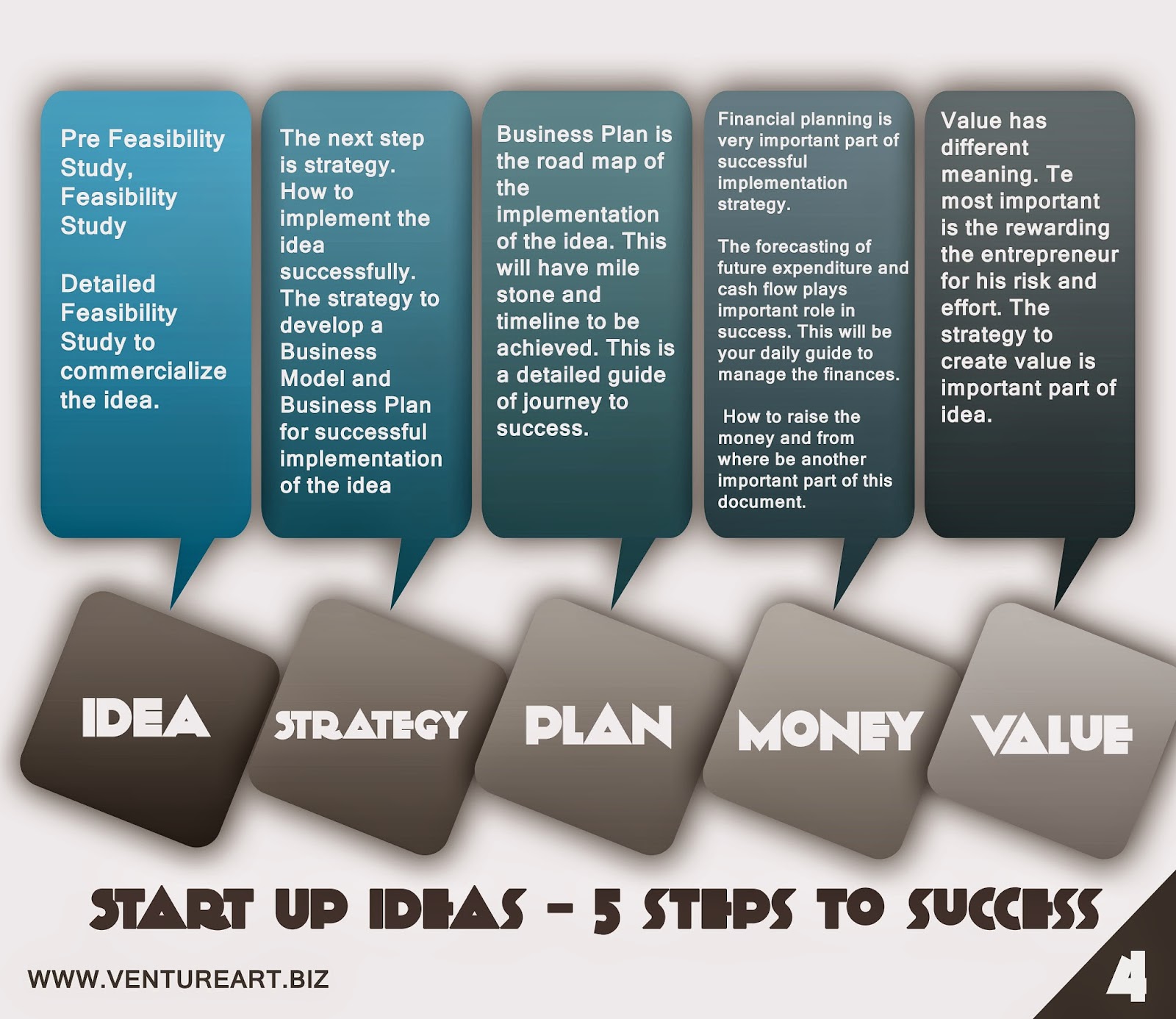
Venture Art - 5 Step Process to Create Value and Build Ideas

Venture Art - Value Creation Road Map
Start-Up Road Map to Success - Building Ideas 

Ideas to Business - Step by Step Solution
Building Ideas - Venture Art

Venture Art Start-Up Solution
Venture Art

Wednesday, November 21, 2012

Ideas and Innovative Products


Acquiring Customers

Virgin Airlines, Expedia, Jet Airways and MakeMyTrip are taking the help of Bangalore-based startup Vizury to analyse massive volumes of digital data on the web and target potential customers.

The four year-old firm is expecting to clock revenue of $ 10 million to $ 12million  this year. However, it has not been an easy journey for the founders—Chetan Kulkarni, Gourav Chindlur and Vikram Nayak—who once worked at US-based Trilogy Software.

It was while chatting over lunch at Trilogy that they decided to quit their jobs and set up Vizury in 2008. They pooled in their savings of $ 2000 and converting Chindlur's bedroom into their office. They ran out of funds after 17 venture capital firms rejected their proposal to develop customer behavior analytics products.

"My wife was expecting and Vikram had to pay a huge lease for the apartment he had bought," says Kulkarni. They almost decided to shut down operations. That is when eight friends and angels came to their rescue, with crowd-sourced funding of $150,000 (Rs 80 lakh now) in 2009, which was used to develop a customer analytics product.